Loading...

When engaging a professional cleaning or restoration provider, you may come across the acronym IICRC. But what does it actually mean — and why should it matter to property owners, facility managers and insurers?

In the cleaning and restoration industry, IICRC alignment is a benchmark for technical credibility, structured methodology and risk-managed outcomes.

What Is the IICRC?

The Institute of Inspection, Cleaning and Restoration Certification (IICRC) is an internationally recognised standards and certification body for the cleaning, inspection and restoration industry.

The IICRC develops procedural standards and provides technician certifications covering areas such as:

  • Carpet cleaning
  • Water damage restoration
  • Fire and smoke restoration
  • Mould remediation
  • Upholstery cleaning
  • Applied structural drying

These standards provide clear, evidence-based guidance on how work should be performed — not just what should be done.

Learn more about IICRC standards.

Why IICRC Standards Matter

In professional cleaning and restoration, process matters just as much as equipment.

IICRC standards provide:

  • Documented methodologies
  • Defined safety procedures
  • Contamination control protocols
  • Fibre and material identification guidance
  • Risk management frameworks

This ensures that cleaning and restoration work is not based on guesswork, but on recognised technical principles.

For property owners, this means greater confidence that the work performed follows structured industry benchmarks.
IICRC S100: Carpet Cleaning Standards Explained

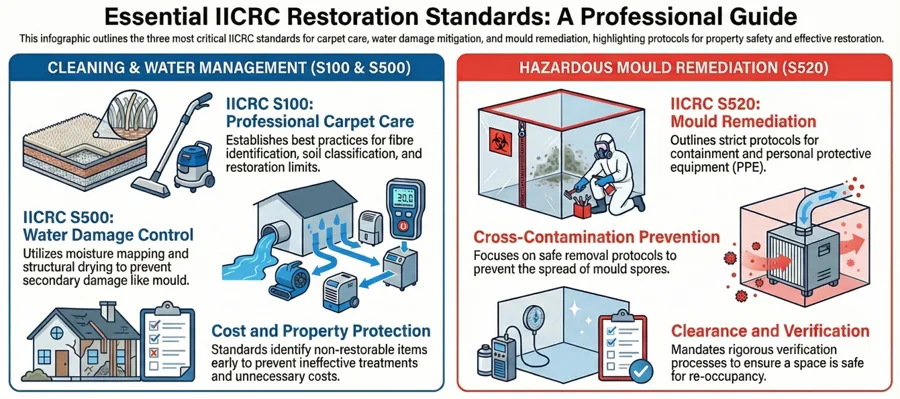
One of the most referenced standards is IICRC S100, which outlines best practice procedures for professional carpet cleaning.

The S100 standard addresses:

  • Pre-inspection requirements
  • Fibre identification
  • Soil classification
  • Cleaning method selection
  • Spot and stain treatment protocols
  • Post-cleaning inspection

Importantly, S100 also clarifies when carpet is deemed non-restorable — such as when contamination permanently alters fibres or backing materials.

This protects property owners from ineffective treatments and unnecessary costs.

IICRC S500: Water Damage Restoration

For water-related events, the IICRC S500 standard provides guidance on:

  • Water classification
  • Drying methodologies
  • Moisture mapping
  • Structural drying procedures
  • Contamination control

In water damage situations, following a recognised standard is critical for preventing secondary damage such as mould growth or structural deterioration.

IICRC S520: Mould Remediation

When mould is present, remediation must be handled carefully to prevent cross-contamination.

The IICRC S520 standard outlines:

  • Containment procedures
  • Personal protective equipment (PPE) requirements
  • Safe removal protocols
  • Clearance and verification processes

This structured approach ensures both property and occupant safety.

The Difference Between Certified and Non-Certified Providers

Not all cleaning companies operate to recognised standards.

A provider aligned with IICRC principles typically demonstrates:

  • Formal technician training
  • Structured assessment procedures
  • Documented reporting
  • Method selection based on fibre/material type
  • Compliance-focused delivery

This reduces risk in high-value or regulated environments such as:

  • Commercial buildings
  • Healthcare facilities
  • Education sites
  • Government properties
  • Insurance-related restoration projects

IICRC Alignment and Insurance Claims

In restoration scenarios involving insurers, documented methodology is essential.

IICRC-aligned processes provide:

  • Defensible reporting
  • Clear scope definition
  • Structured damage classification
  • Transparent justification for restoration vs replacement

This clarity supports claim processing and minimises disputes.

Why Standards Protect Your Assets

Carpets, upholstery and building materials are assets — not just surfaces.

Incorrect cleaning methods can lead to:

  • Shrinkage
  • Browning
  • Delamination
  • Wicking stains
  • Fibre distortion

Following IICRC guidelines helps prevent avoidable damage and protects the lifespan of materials.

Choosing an IICRC-Aligned Provider in Australia

When selecting a professional cleaning or restoration company, consider:

  • Are technicians formally trained?
  • Is the process documented?
  • Are recognised industry standards followed?
  • Is the provider experienced in compliance-driven environments?

Elite Maintenance Services Group aligns its methodology with recognised IICRC standards to ensure professional, accountable and technically sound outcomes across residential, commercial and restoration projects.

To learn more about our standards alignment, visit here.

Book a Professional Assessment

Whether you require carpet cleaning, water damage restoration or mould remediation, choosing a standards-aligned provider protects both your property and your investment.

Request a quote online

Or call 131 580 to speak with our team.

Elite Maintenance Services Group

Experts Since 1984 – Australia Wide With Pride

Talk to Our Team

Engage a provider built for compliance, scale, and long-term asset protection.

Call 131 580 Elite Logo Enquiry Elite Logo Booking